

Secure online wholesale ordering: costs, terms and setup
- Posted on
TRADENET
- 0
- Categories: Uncategorized

A 24/7 wholesale ordering system is difficult because it must do more than display products. It needs to present supplier terms clearly and connect product selection with order, payment, and delivery details. Secure online wholesale ordering depends on getting those parts to work together, including when buyers and suppliers operate across borders.
It’s easy to see why round-the-clock ordering appeals to growing brands: buyers can place orders on their own schedules. A reliable process, however, depends on clear purchasing terms, useful product information, and attention to international requirements. This article explains how supplier minimums and payment terms shape buying decisions, what to review in an ordering setup, and how currency, tax, and shipping affect cross-border purchases. Use it as a practical framework for evaluating the details before choosing how to order.
Key Takeaways
- Compare supplier minimums and payment terms against your order size and cash-flow needs before committing.
- Plan ordering around accurate product and inventory information so buyers can place orders smoothly outside business hours.
- Use clear product categories and searchable details to narrow supplier options and assess fit for your purchasing needs.
- Account for currency, language, tax, and shipping factors when assessing cross-border orders and their landed costs.
Comparing wholesale supplier minimum orders and payment terms
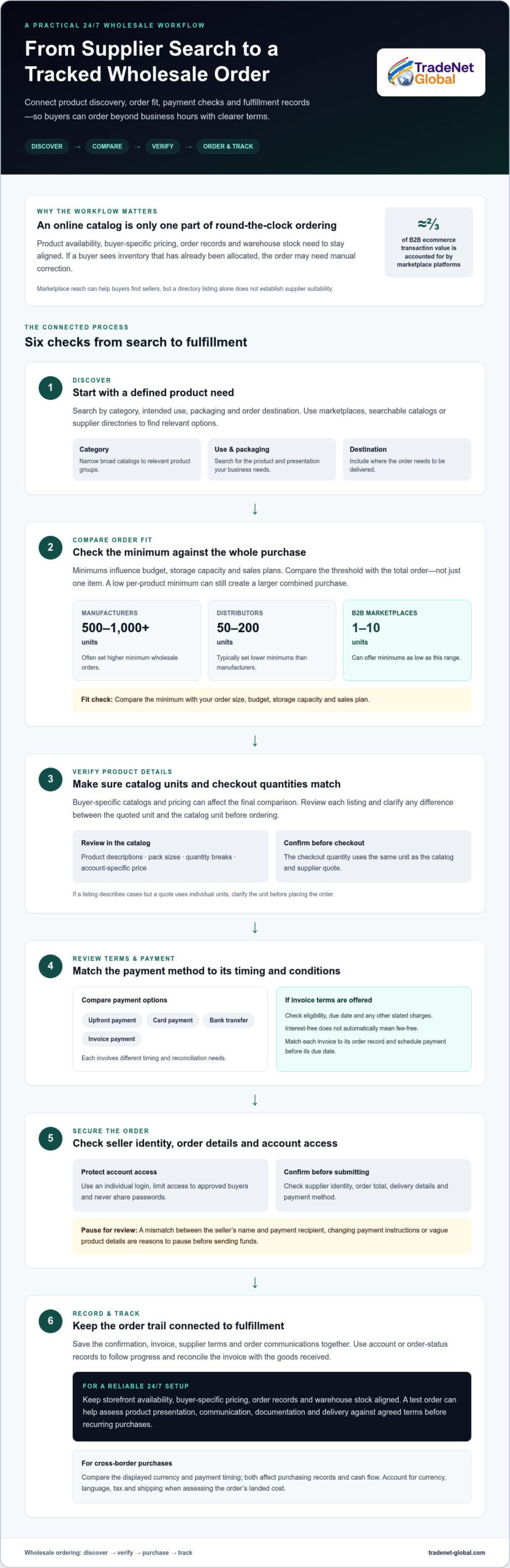
Minimums shape whether an order fits a buyer’s budget, storage capacity, and sales plan. Manufacturers often set minimum wholesale orders of 500-1,000+ units, while distributors typically set 50-200 units. B2B marketplaces can offer minimums as low as 1-10 units. Compare the threshold with the total order, not just one item. A low per-product minimum can still mean a larger combined purchase.
Buyer-specific catalogs and pricing affect the final comparison. Review product descriptions, pack sizes, quantity breaks, and the price shown in your account. Confirm that the checkout quantity uses the same unit as the catalog. Compare payment terms as well: upfront payment, card payment, bank transfer, and invoice payment each involve different timing and reconciliation needs.
Interest-free invoice terms, where offered, let eligible buyers pay an invoice by its stated due date without interest. Read the invoice conditions, including eligibility, due date, and any other stated charges. Interest-free does not automatically mean fee-free. Match each invoice to its order record, and schedule payment before the due date to avoid missed obligations.
For secure online wholesale ordering, assess how the portal handles accounts and payment details. Use an individual login, limit access to approved buyers, and never share passwords. At checkout, confirm the supplier’s identity, order total, delivery details, and payment method before submitting the order. Keep the confirmation and invoice together for reconciliation. These checks support clear records and help prevent avoidable payment errors.
To place and track an order, select catalog items, enter quantities, review the supplier’s minimums and terms, then submit payment or an invoice request. Save the confirmation and use the account or order status records to follow progress. Buyers in America ordering internationally should compare the displayed currency and payment timing, since both affect purchasing records and cash flow.
What Makes Implementing 24/7 Online Ordering So Difficult for Brands Growing Through Wholesale?
An online catalog can accept orders at any hour, but fulfillment depends on connected operations. Product availability, buyer-specific pricing, order records, and warehouse stock need to stay aligned. If a buyer sees inventory that has already been allocated, the order may need manual correction. A dependable setup links the storefront with the systems used to manage inventory and process orders.
Wholesale buyers can discover suppliers through marketplaces, searchable catalogs, and supplier directories. Marketplace platforms account for roughly two-thirds of B2B ecommerce transaction value. These channels help buyers compare categories and locate sellers, but a directory listing alone doesn’t establish that a supplier is suitable. Compare product details, order conditions, communication, and the steps for submitting an order.
Due diligence starts with the supplier’s business identity and the consistency of its information. Compare the company name across its profile, catalog, invoice, and payment instructions. Review product descriptions and ordering terms for clear units, quantities, and delivery responsibilities. A mismatch between the seller’s name and payment recipient, changing payment instructions, or vague product details are reasons to pause before sending funds.
Keep a record of what you reviewed. Save the supplier profile, catalog details, written terms, and order communications together. If a listing describes cases but the quote uses individual units, clarify the unit before placing the order. This helps prevent confusion when comparing quotes or reconciling the invoice with the goods received.
A test order can help assess the transaction process before you rely on it for recurring purchases. Choose a manageable order that lets your team evaluate product presentation, communication, documentation, and delivery against the agreed terms. Record any differences and resolve them before expanding order volume. For growing brands, these checks make marketplace discovery more useful and reduce avoidable friction in a round-the-clock ordering process. For a broader framework, review these reliable wholesale product supplier options for comparing costs and risks.
Wholesale supplier and product discovery
Supplier discovery works best when buyers start with a defined product need. Search by category, intended use, packaging, and order destination. A retailer sourcing dairy products, for example, can compare listings by product type and purchasing unit before reviewing individual offers. This narrows broad catalogs and helps separate relevant options from unrelated results. Record useful search terms so colleagues can repeat the process.
Catalog size alone does not show whether a supplier’s products suit your business. For catalogs covering many brands, look for clear categories, searchable product details, and useful filters. Check whether each listing identifies the product, unit, and relevant ordering details. Save promising items to a shortlist, then compare like with like. A brand name can help with discovery, but the product description must still match your requirements.
Custom or decorated products need a more specific comparison. Define the requested design, placement, quantity, and approval process in writing. Compare the supplier’s product information with the intended result before adding items to the cart. For example, a retailer ordering printed packaging should distinguish the base product from the decoration requirements. Keep design files and approved proofs with the order record so the checkout details reflect the agreed version.
Retailers can organize discovery by the categories they sell, such as food, household goods, or apparel. Wholesale categories help teams find related products, while filters narrow results to a particular item or brand. If sourcing across several categories, compare each group separately because product specifications and order units can differ. Use a shortlist with columns for product name, supplier, unit, and key requirements. This makes purchasing reviews more consistent across the team.
Before checkout, compare the selected product details with your shortlist and purchase plan. Confirm that the listing matches the intended category, brand, packaging, and decoration details. For example, check that a decorated item is not confused with its undecorated version. A clear discovery process connects catalog browsing with an accurate order, supporting secure online wholesale ordering.
International currencies, languages, taxes, and shipping
For U.S. wholesale purchases, tax treatment depends on the transaction, product, buyer location, and whether goods cross a border. Import tariffs can also affect landed costs, so include them when assessing the full order value.
Currency affects how buyers compare quotes and record purchases. Check which currency appears in the catalog, checkout, invoice, and payment confirmation. If those records use different currencies, the order total and accounting entry may not match directly. Save the displayed currency with each quote and compare like-for-like amounts using your chosen accounting method.
Language matters at key points, not only in product descriptions. Review checkout labels, invoice terms, shipping details, and payment instructions in a language your purchasing team can interpret. Unclear product units or delivery terms, for example, can lead to an order that differs from the intended purchase. Save the product listing and order confirmation together for reference.
U.S. tariffs were introduced and expanded in 2025 and 2026, raising landed costs on imported wholesale products from several sourcing regions. The effect depends on the product and sourcing region. Research the product’s origin and include applicable tariff costs in your landed-cost estimate before selling the goods onward. Low-cost consumer goods priced between $5 and $50 at retail have been especially affected by removal of the U.S. de minimis exemption for duty-free imports. Compare tariff exposure and other order terms when evaluating a reliable wholesale product supplier.
Shipping comparisons should include more than the quoted transport charge. Review the delivery destination, stated shipping terms, expected handoff points, and any charges shown in the order documents. Keep these details with the invoice and product record. This gives purchasing and finance teams a clearer basis for comparing suppliers and tracking cross-border orders.
For wholesale product options, browse available wholesale categories and compare product details with your purchasing needs.
U.S. tax treatment depends on the transaction, product, buyer location, and whether the purchase crosses a border. For imported goods, include applicable tariffs in the landed cost. The removal of the de minimis exemption has especially affected low-cost consumer goods.
TRADENET GLOBAL: Confectionery
TRADENET GLOBAL sells confectionery through a searchable online wholesale store. It’s a practical option for buyers sourcing confectionery alongside other wholesale products. The catalog also includes wood pellets, beverages, and beer, so buyers can explore several product categories in one place.
Browse the product listings to explore relevant options and review order details before buying. Clear product information and secure payment options support a straightforward online purchase process. If you’re comparing categories, the searchable store makes it easier to find products that fit your purchasing plans.
If confectionery or another listed category fits your wholesale requirements, visit tradenet-global.com to explore the store or contact TRADENET GLOBAL.
Make your next ordering decision easier
Make procurement a repeatable process. Set clear internal responsibilities for catalog review, order approval, and record keeping. A shared workflow helps buyers handle routine purchases consistently, even as product needs or team members change. It also gives your business a practical basis for improving secure online wholesale ordering over time.
Choose an ordering approach that fits your team’s purchasing needs. Keep product requirements and records organized, and make the next step clear for everyone involved. Small process improvements can reduce confusion and help your team focus on planned purchasing.
For your next wholesale purchase, explore the online store or contact TRADENET GLOBAL. Take the next step at a pace that works for your business.
Frequently Asked Questions
What does secure online wholesale ordering involve?
Secure online wholesale ordering is a digital process for selecting goods, submitting purchase details, and paying through an online system with safeguards for accounts and transaction data. It involves more than browsing a catalog. Buyers should be able to access an order confirmation, for example, without exposing account credentials or sending payment details through an unrelated channel.
Which wholesale ordering platforms offer secure payment processing?
Wholesale stores and B2B marketplaces may offer secure payment processing when checkout uses a protected payment service. Look for a clear payment flow that identifies the payment recipient and provides a transaction record. If a seller asks you to move payment outside the platform, review its terms first, since the platform’s payment protections may not apply.
How can buyers verify a wholesale supplier is legitimate in the United States?
Compare the supplier’s registered business name with its storefront, invoices, and payment recipient. For a U.S. supplier, check the relevant state business registry and review the company’s address and contact details. Request written product and order terms, then compare them with the listing. Inconsistent names, unexplained changes, or pressure to pay unusually quickly are reasons to pause.
What payment methods and buyer protections are available for online wholesale orders?
Available payment methods can include cards, bank transfers, and invoice arrangements, depending on the seller and platform. Buyer protections vary by payment provider and transaction terms. Save the listing, order confirmation, invoice, and written communications. If goods arrive differently from the written order, these records can help explain the issue through the platform’s or payment provider’s dispute process.
What security features should a wholesale ordering website have?
A secure online wholesale ordering website should use an encrypted connection, protect account access, and identify the payment recipient at checkout. Multi-factor authentication and separate user permissions can help businesses control who places or approves orders. A clear privacy notice should explain how account and transaction information is handled. Staff who only view catalogs, for example, may not need permission to submit purchases.
How do wholesale platforms protect buyer and supplier data?
Platforms can reduce data exposure by limiting access to authorized users, encrypting information during transfer, and collecting only details needed for ordering and payment. Buyers should use unique passwords and remove access when a team member no longer handles purchasing. Suppliers can keep order records in controlled business accounts rather than sharing customer files through open links or personal email.
