

Reliable wholesale product supplier options for comparing costs and risks
- Posted on
TRADENET
- 0
- Categories: Uncategorized

The lowest unit quote can become the costliest order. A reliable wholesale product supplier should be compared by the full cost and risk of buying, not by the product price alone. In the United States, tariffs introduced and expanded in 2025 and 2026 raised landed costs on imported wholesale products from several key sourcing regions, particularly China.
Price matters, but order terms, product quality, delivery arrangements, and supplier reliability all affect a purchase’s real value. This guide explains how to compare supplier costs, assess sourcing routes, account for tariff exposure, and verify a supplier before ordering. Use these practical checks to weigh trade-offs and make a decision based on more than a low quote.
Key Takeaways
- Compare the full landed cost, including tariff exposure and other order terms, rather than choosing by unit quote alone.
- Assess suppliers against practical criteria such as product fit, quality information, payment terms, and delivery arrangements.
- Match reseller options to your purchasing needs, stock plans, and tolerance for sourcing risk.
- Use a consistent due-diligence process to review supplier identity, business details, and transaction terms before ordering.
1. International sourcing and tariff considerations
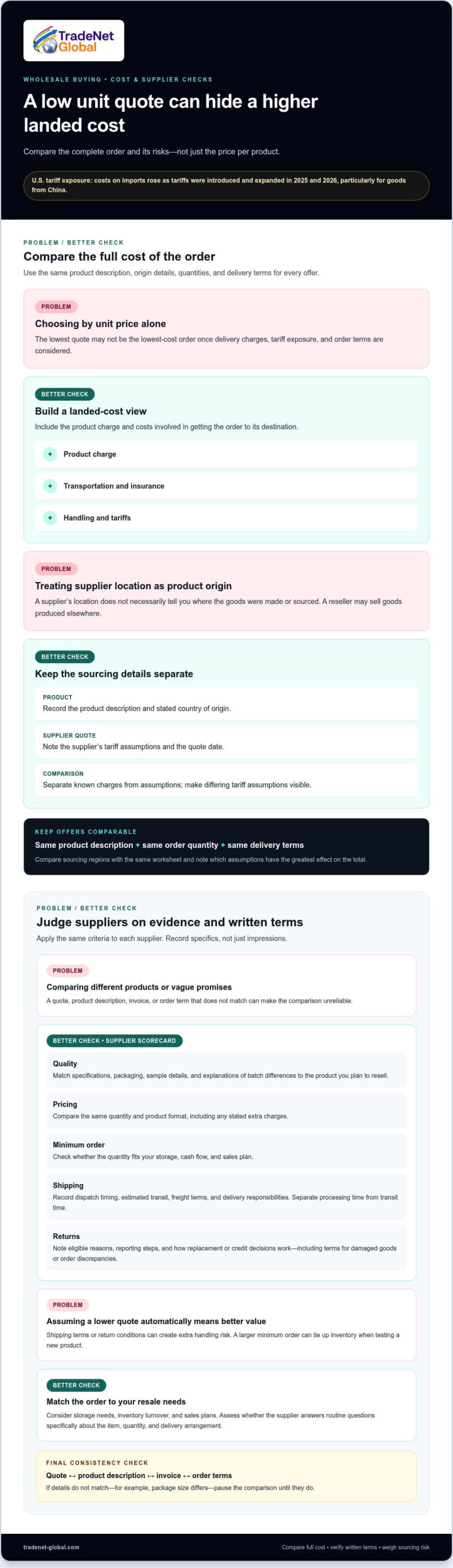
Tariff exposure can change the economics of an imported wholesale order. Tariffs introduced and expanded in 2025 and 2026 raised landed costs on imported wholesale products from several key sourcing regions, particularly China. Compare each source using the same product description, origin details, and order assumptions.
Record the product’s country of origin and the supplier’s stated tariff assumptions. A supplier’s location does not necessarily indicate where its goods were made or sourced. For example, a reseller in one country may sell goods produced in another. Keep these details separate when comparing offers.
Build a landed-cost comparison instead of ranking offers by unit price alone. Include the product charge and any costs involved in getting the order to its destination, such as transportation, insurance, handling, and tariffs. Use the same quantities and delivery terms for each offer so you are comparing like with like.
- Record the product description and stated origin.
- Note the supplier’s tariff assumptions and quote date.
- Compare equivalent order quantities and delivery terms.
- Separate known charges from assumptions in your worksheet.
Consider how changes in tariff exposure could affect your decision. Compare suppliers and sourcing regions using the same worksheet, and note which assumptions have the greatest impact on the total. If offers rely on different tariff assumptions, make that difference clear rather than treating them as equivalent.
For purchases in the United States, treat tariff exposure as part of sourcing risk, not as a minor adjustment after choosing a supplier. A reliable wholesale product supplier should provide enough sourcing and order information for you to assess offers on consistent terms. Compare before committing, particularly when goods come through resellers or from regions affected by changing tariff conditions.
2. Supplier evaluation criteria
Compare suppliers using identical product descriptions and order conditions. Assess quality by reviewing specifications, sample consistency, packaging details, and explanations of batch differences. Compare total quoted prices, minimum order quantities, and shipping terms side by side. This makes trade-offs clear without assuming the lowest quote offers the best value.
Record shipping times, freight costs, and return policies as written order terms. Separate processing time from transit time, note which freight charges are included, and identify the conditions and costs for returns, damaged goods, or order discrepancies.
Use a simple scorecard to keep comparisons consistent. Apply the same criteria to each supplier and record evidence, not just impressions.
- Quality: Match specifications, packaging, and sample details to the product you plan to resell.
- Pricing: Compare the same quantity and product format, including any stated extra charges.
- Minimum order: Check whether the required quantity fits your storage, cash flow, and sales plan.
- Shipping: Record dispatch timing, estimated transit, freight terms, and delivery responsibilities.
- Returns: Note eligible reasons, reporting steps, and how replacement or credit decisions work.
Check that the quote, product description, invoice, and order terms are consistent. If a quote describes one package size but the invoice lists another, pause the comparison until the details match. Clear documentation helps prevent misunderstandings and keeps purchasing records accurate. Assess how promptly and specifically the supplier answers routine product questions, too. A useful response addresses the item, quantity, and delivery arrangement rather than relying on broad assurances.
Keep the final comparison tied to your resale needs. A larger minimum order may suit a steady seller but tie up inventory for a new product test. A lower quote may offer less value if shipping terms or return conditions create extra handling risk. For a product-specific comparison, review the Dairy Products range against your quality and order requirements.
3. Supplier options for resellers
Resellers may source through manufacturers, authorized distributors, importers, domestic wholesalers, or online wholesale marketplaces. Each route creates a different buying relationship. A manufacturer may suit a repeatable product line, while a distributor may consolidate goods from multiple brands. Compare product fit, order flexibility, communication, and terms, rather than relying on the route label alone.
Wholesale prices, minimum order quantities, and payment terms vary with the product, quantity, packaging, sourcing route, and agreed order terms. No single benchmark applies across categories. Compare written quotes for the same specification, quantity, delivery basis, and payment schedule. Otherwise, an apparent price advantage may reflect a different purchase.
In the United States, build a supplier shortlist using industry trade associations, trade shows, manufacturer directories, and wholesale marketplaces. Treat each listing or introduction as a lead, not proof of suitability. Compare the supplier’s business identity, product details, order terms, and responsiveness to find options that fit your needs.
Choose a sourcing route that fits your stock plan. A reseller testing demand may prioritize flexible order quantities, while an established seller may value consistent replenishment or a broader assortment. For example, compare a direct importer’s product-specific offer with a distributor’s combined range. Then consider storage needs, inventory turnover, and the work involved in managing separate orders.
- Manufacturers: Consider direct sourcing for a focused, repeatable product line.
- Distributors: Compare consolidated assortments and the terms for each product.
- Importers: Review origin, product details, and the order conditions together.
- Marketplaces: Use listings to identify candidates, then assess each supplier directly.
A reliable wholesale product supplier should suit both your resale plan and product category. Make a comparison table with one row per supplier and matching quote details. Note which sourcing route best supports your stock needs, then verify the strongest candidates.
4. Supplier verification and due diligence
Before placing a wholesale order, compare the supplier’s business identity across its quote, invoice, and payment details. Check that the company name and contact information are consistent. Review product descriptions, order terms, and written answers together. If seller names differ between the invoice and payment instructions, resolve the discrepancy before sending funds.
Request a representative sample before committing to a larger order. Compare it with the written specification and intended resale use, then assess its materials, appearance, packaging, and condition. Record the sample details and keep them with the product description. This provides a clear reference for evaluating delivered goods.
Review transaction terms before paying. Confirm what the invoice covers, the payment method, delivery responsibilities, and the process for reporting an order problem. Keep messages, product specifications, and payment records together. If an invoice changes the agreed package description, resolve the discrepancy in writing before proceeding.
- Identity: Match business names and contact details across supplier records and order documents.
- Product: Compare sample characteristics with the written description and your resale requirements.
- Payment: Ensure payment instructions match the documented seller and order terms.
- Records: Save quotes, invoices, sample notes, and supplier communications together.
Judge supplier replies by how directly they answer your questions. If you ask about sample specifications, the response should address those details rather than offer only a general assurance. Track unresolved differences in a short checklist and review each item before approving the order. This creates a practical record for comparing the sample, agreed terms, and goods received.
Use these checks to prepare for a wholesale purchase. Review wholesale product options as you compare product details and order information.
TRADENET GLOBAL: Confectionery
TRADENET GLOBAL offers Confectionery for buyers comparing wholesale products for resale or business purchasing. Its searchable online store lets buyers review the category and consider whether it suits their needs.
Consider TRADENET GLOBAL when comparing confectionery with other wholesale categories. Its store also lists Beverages, Beer, and Wood Pellets, giving buyers options to review in one place. Compare product details and order terms with your requirements before ordering.
TRADENET GLOBAL offers an online store with secure payments for wholesale purchasing. Visit the store to review Confectionery options and browse other categories, then contact TRADENET GLOBAL to discuss your purchasing needs.
Set a clear standard for your next order
Make supplier comparisons a repeatable part of purchasing. Before each order, decide what matters most, such as product fit, stock planning, or payment terms, and record why you chose that offer. This gives your team a practical reference when needs change or a new supplier is considered.
A reliable wholesale product supplier should help you align purchasing decisions with your business priorities. Base each decision on the specific order, not familiarity or one attractive term alone. Revisit your priorities as your product mix and resale plans change.
For your next sourcing decision, contact TRADENET GLOBAL for sourcing support. Take the next step with a clear view of what your business needs.
Frequently Asked Questions
How can I verify that a wholesale product supplier is legitimate and reliable?
Check that the supplier’s business identity, contact details, and payment recipient match across records. Compare the seller name on the quote with the invoice and payment instructions. Review written terms and product information, and keep the records together. If a company name changes between documents, resolve the inconsistency before paying.
What certifications, licenses, and business documents should a U.S. wholesale supplier provide?
Request documents relevant to the product and transaction rather than assuming one certificate applies to every wholesale category. Useful records may include business identification, invoices, written sales terms, and relevant product certifications or permits where applicable. For regulated categories, identify the documents that relate to the specific product. Keep copies with your order file so you can match the records to the goods received.
What red flags indicate a wholesale supplier may be fraudulent or unreliable?
Watch for inconsistent business names, unexpected changes to payment instructions, vague product descriptions, and pressure to pay before terms are clear. A supplier’s refusal to put important details in writing also makes an order harder to assess. If a revised invoice names a different seller or recipient, pause the transaction and resolve the discrepancy through a separate, trusted contact route.
What steps should I follow to vet and negotiate with a wholesale supplier?
Start with a written product and quantity specification, gather comparable quotes, and review each supplier’s terms. Ask focused questions about the order, sample details, payment schedule, and remedies for discrepancies. Put negotiated changes in writing, including revised product descriptions or delivery terms. Before approving the purchase, match the final invoice to the agreed quote and keep the correspondence with your order records.
What are typical wholesale prices, minimum order quantities, and payment terms?
Wholesale prices, minimum order quantities, and payment terms vary with the product, quantity, packaging, sourcing route, and agreed order terms. Compare written quotes using the same specifications, quantity, delivery basis, and payment schedule.
