

Bulk Baby Milk Powder Supplier Pricing and Order Sizes
- Posted on
TRADENET
- 0
- Categories: Uncategorized

Order size can matter as much as the product itself. A bulk baby milk powder supplier may set minimums by product and order format; one listed infant formula offer has a 100-carton minimum. Pricing also depends on the formula specification and packaging, so buyers need to compare like with like.
It’s reasonable to want clear figures before committing to a large order. Compare more than the price per unit: minimum order quantity, sample availability, technical datasheets, and certification options all affect whether a product meets your purchasing requirements. A low quoted price alone doesn’t show the full value of an order.
This guide explains how to assess infant formula pricing and order sizes, what to look for in samples and technical documents, and how certification options can shape sourcing decisions. It also covers the details that make supplier offers easier to compare, so you can plan a bulk purchase with a clear view of product and documentation requirements.
Key Takeaways
- Compare infant formula offers by product stage, specification, packaging, and order minimum, not by price alone.
- Use samples and technical datasheets to assess product fit and compare key specifications before planning a purchase.
- Consider kosher, halal, and rBST-free attributes as sourcing criteria, and match them to your product requirements.
- Minimum order quantities can differ by product and format, so factor the order size into your sourcing plan.
Infant formula prices and minimum order quantities
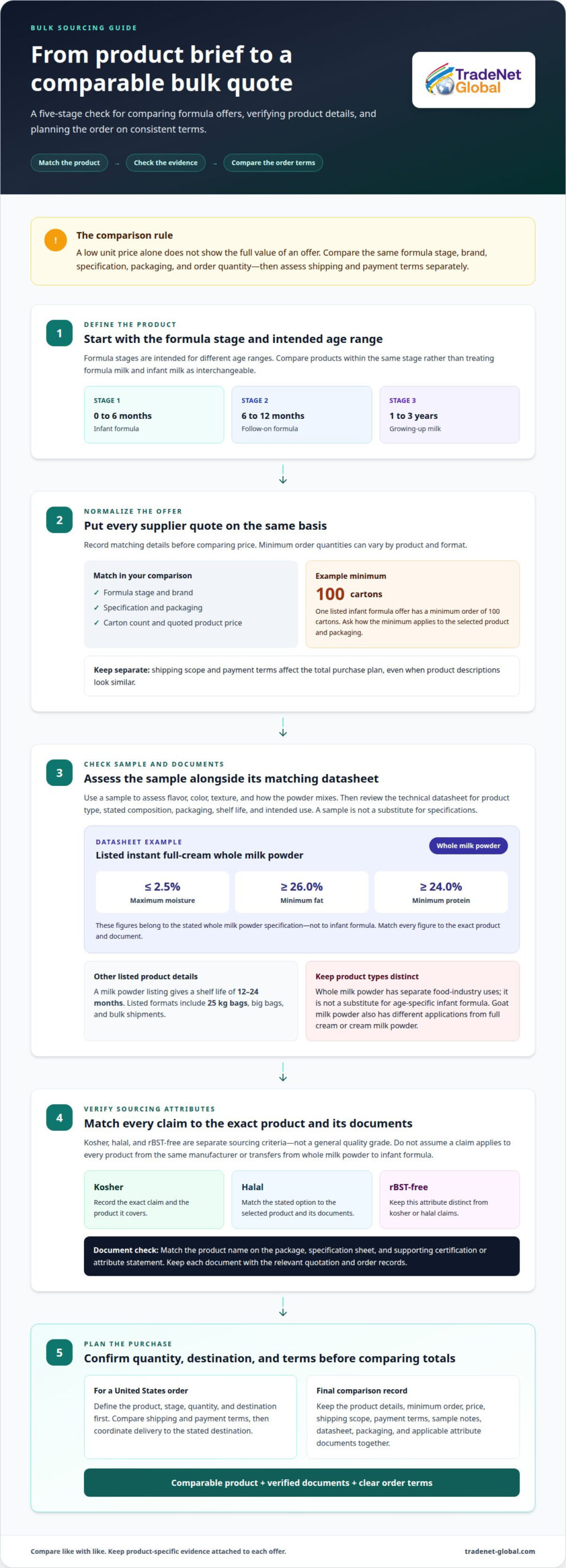
Compare global suppliers and distributors by matching the same formula stage, brand, pack format, and order quantity. Then compare the quote’s shipping scope and payment terms separately; these details affect the total purchase plan, even when product descriptions look similar. A bulk baby milk powder supplier may set minimums by product: one listed infant formula offer has a minimum order of 100 cartons.
Stage matters because infant formula products are intended for different age ranges. Stage 1 formula is intended for babies aged 0 to 6 months. Stage 2 follow-on formula is intended for babies aged 6 to 12 months. Stage 3 growing-up milk is intended for children aged 1 to 3 years. Compare products within the same stage rather than treating formula milk and infant milk as interchangeable.
Read the ingredients and specification together. One listed formula specification includes 13 vitamins and 13 minerals. Compare the stated composition and product purpose across offers, and keep infant formula specifications distinct from those for general dairy powder. Whole milk powder has separate food-industry uses: it can be used to create fluid milk or fortify infant formula. Its role in a production process doesn’t make it a substitute for age-specific infant formula.
For a practical comparison, record the product stage, brand, carton count, quoted product price, shipping terms, and payment terms in matching columns. The market price alone won’t tell you whether an offer suits your required order size. Ask how the minimum applies to the chosen product and packaging, then compare offers on the same basis.
For an order in the United States, define the product, stage, quantity, and destination first. Compare the supplier’s shipping and payment terms, place the order on those terms, and coordinate delivery to the stated destination.
Product samples and technical datasheets
A sample can help you compare flavor, color, texture, and how the powder mixes. Assess it alongside the matching technical datasheet, not as a substitute for specifications. For wholesale purchasing, record the product type, stated composition, packaging, shelf life, and intended use. This makes offers easier to compare across milk powder wholesale and powder wholesale listings.
Product types have different features. Whole milk powder is spray-dried from fresh, full-fat milk. Regular whole milk powder is commonly used for processing that involves high-temperature mixing or blending; instant whole milk powder dissolves more easily in cold water. Low-heat and medium-heat varieties are also offered. Goat milk powder serves different food and non-food applications, so distinguish it from full cream milk or cream milk powder in the product documents.
Read each specification as a complete set. One listed instant full-cream whole milk powder specification sets maximum moisture at 2.5%, minimum fat at 26.0%, and minimum protein at 24.0%. Whole milk powder typically contains 26-28% milk fat, but that general range is not a substitute for the individual product’s datasheet. A listed milk powder product has a shelf life of 12-24 months. Match every figure to the exact product and document.
Packaging affects order planning and handling. Listed formats include 25 kg bags, big bags, and bulk shipments; another full-cream product is packed in 25-kilogram bags or 1,000-kilogram big bags. Keep packaging details separate from infant formula age stages, which identify intended use rather than pack size.
Overseas or unauthorized sourcing can make product identity, composition, and document reliability harder to establish. Compare the sample label with the datasheet and order description, and don’t treat a general specification as proof of a specific product’s quality.
For a practical sourcing comparison, review the baby milk powder range alongside its stated product details, then assess each offer against your intended use and packaging needs.
Kosher, halal, and rBST-free options
Whole milk powder listings can include kosher, halal, and rBST-free attributes. Treat each as a separate sourcing requirement, not a general quality grade. A claim attached to whole milk powder should match the product and its documentation. Don’t assume it applies to every product from the same manufacturer or to infant milk formula.
Start with the intended product. Full cream whole milk powder and instant whole milk powder are different product descriptions, so compare the stated attribute with the exact type you plan to buy. For a nutritional product specification, keep composition details separate from certification information. One describes product characteristics; the other identifies a stated attribute or certification. Neither alone establishes that a product meets every buyer’s requirements.
Review documents before comparing offers. Match the product name on the package, specification sheet, and supporting certification or attribute statement. Note which product the document covers and whether it states kosher, halal, or rBST-free. If a manufacturer offers multiple whole milk powder formats, compare each independently. Keep the documents with the relevant quotation and order records.
- Kosher: Record the exact claim and the product it covers.
- Halal: Match the stated option to the selected product and its documents.
- rBST-free: Keep this attribute distinct from kosher or halal claims.
These steps help prevent a broad catalogue statement from being mistaken for product-specific evidence. They also make comparisons clearer when manufacturers offer full cream, instant, or other whole milk powder types. For infant milk formula, evaluate the formula’s own product information rather than transferring claims from a separate whole milk powder listing. Use required attributes as filters, then compare the remaining products by their stated specifications and intended use.
For bulk sourcing, include each requirement in the purchase specification before reviewing offers. This gives suppliers a clear basis for presenting matching products and documents. Keep claims precise: an rBST-free attribute is not interchangeable with kosher or halal status, and a general nutritional specification does not replace either. A clear record supports consistent review from quotation through order selection.
Minimum order quantities
Minimum order quantities vary by product and order basis. One listed milk powder supplier states a minimum order quantity of 18 metric tons. The listed minimum order for full creamy milk powder is 10 US tons. Minimum orders for full cream milk powder can vary by listing. These are distinct examples, not a universal threshold. Compare the stated product, quantity unit, and packaging before judging whether an offer suits your purchasing plan.
Start with the expected use. A buyer sourcing milk formula needs a different product specification from a food manufacturer purchasing powder for other applications. Whole milk and skimmed milk powders aren’t equivalent products. Organic or premium requirements can also narrow the suitable options, so include them in the product description before evaluating quantities.
- Product: Identify the exact powder type and intended application.
- Order basis: Record whether the minimum is stated in metric tons or another unit.
- Pack format: Compare bag, big-bag, or bulk shipment terms where offered.
Next, check whether the stated minimum matches your planned purchase and storage capacity. A lower unit price doesn’t automatically make a larger quantity practical. Consider how much product your operation can use, how it will be stored, and whether the selected format suits your handling process. Keep each quote tied to its product and unit, especially when comparing direct offers from global suppliers.
For a reliable comparison, organize offers by powder type, minimum quantity, unit, and packaging. Don’t combine figures from different products or convert between US and UK tons without retaining each original unit. This keeps the comparison clear for procurement teams and prevents a minimum for one product from being applied to another.
Review baby milk powder options alongside your required quantity and product type to plan the next sourcing step.
TRADENET GLOBAL: Confectionery
TRADENET GLOBAL offers a practical next step for buyers planning wholesale purchases across product categories. Its range includes confectionery, wood pellets, beverages, and beer. Use the criteria in this guide to organize product requirements, order quantities, and documentation before comparing suitable purchases. This keeps procurement discussions focused on the items your business needs and the details that shape each order.
Confectionery may suit buyers sourcing products for resale or business use, while beverages and beer meet different purchasing needs. Wood pellets offer another category for buyers managing a separate supply requirement. Keep each request specific to the product category and intended use to make the discussion clear and relevant.
Contact TRADENET GLOBAL to discuss your wholesale requirements.
Make Your Next Sourcing Step Clear
Turn your sourcing requirements into a concise purchasing brief. Define the product type, intended use, packaging needs, documentation criteria, and order quantity. This gives a bulk baby milk powder supplier a clear basis for responding to your request and helps your team assess offers consistently.
Keep the process practical: record the decisions that matter to your operation, then use them to guide the next procurement conversation. TRADENET GLOBAL also offers confectionery, wood pellets, and beverages for buyers with other product needs. Consider each category separately according to your purchasing priorities.
To move forward, share your requirements with TRADENET GLOBAL through its website. A clear brief makes it easier to focus the discussion on the products and order details relevant to your business. Visit TRADENET GLOBAL and take the next sourcing step with confidence.
Frequently Asked Questions
What types of bulk infant formula and baby milk powder are available to U.S. buyers?
Buyers may encounter stage-based infant formula, whole milk powder, and goat full cream milk powder. These categories aren’t interchangeable. Infant formula is intended for infant feeding, while whole milk powder also serves other food-industry applications and can be used to fortify infant formula. Compare each product’s intended use, composition, and documentation rather than relying on category names alone.
Who are reputable wholesale suppliers of infant formula in the United States?
TRADENET GLOBAL is an online wholesale supplier of baby milk powder. Buyers can browse its product categories and compare relevant product details with their purchasing requirements. For a U.S. purchase, assess whether the product description, order terms, and delivery arrangements fit your business needs. Judge a supplier’s reputation by clear transaction information and product-specific documentation, not by broad claims alone.
What are the minimum order quantities for bulk baby formula suppliers?
Minimum order quantities vary by product and supplier, so use the quantity stated for the exact item you plan to purchase. Before comparing offers, record the unit, package format, and whether the minimum applies to one product or a combined order. Then compare that commitment with your expected use and storage capacity. This helps prevent mismatched quantities from distorting supplier comparisons.
How much does bulk infant formula cost per unit or case in the U.S.?
Compare quotes using the same product, package size, and order basis. The final comparison also depends on the quantity ordered, delivery terms, and payment terms. Keep product charges separate from any other transaction costs shown in the offer. A case-level quote and a per-unit figure make sense side by side only when both refer to matching products and packaging.
How can businesses verify a baby milk powder supplier and product authenticity?
Match the product name and identifying details across the package, technical datasheet, quotation, and order record. Check that the documents describe the same product and intended use. Keep product-specific records together, including any supplied batch or lot identifiers. This creates a clear paper trail for receiving checks and helps teams spot discrepancies between the ordered item and its documentation.
What certifications and quality standards should wholesale infant formula suppliers meet?
Start with the buyer’s product and market requirements, then review documentation for the exact item. For products carrying kosher, halal, or rBST-free claims, assess each claim separately and match it to the relevant product records. Compare the technical specification with the intended use as well. These checks help distinguish certification or attribute claims from composition and product-quality details.
