



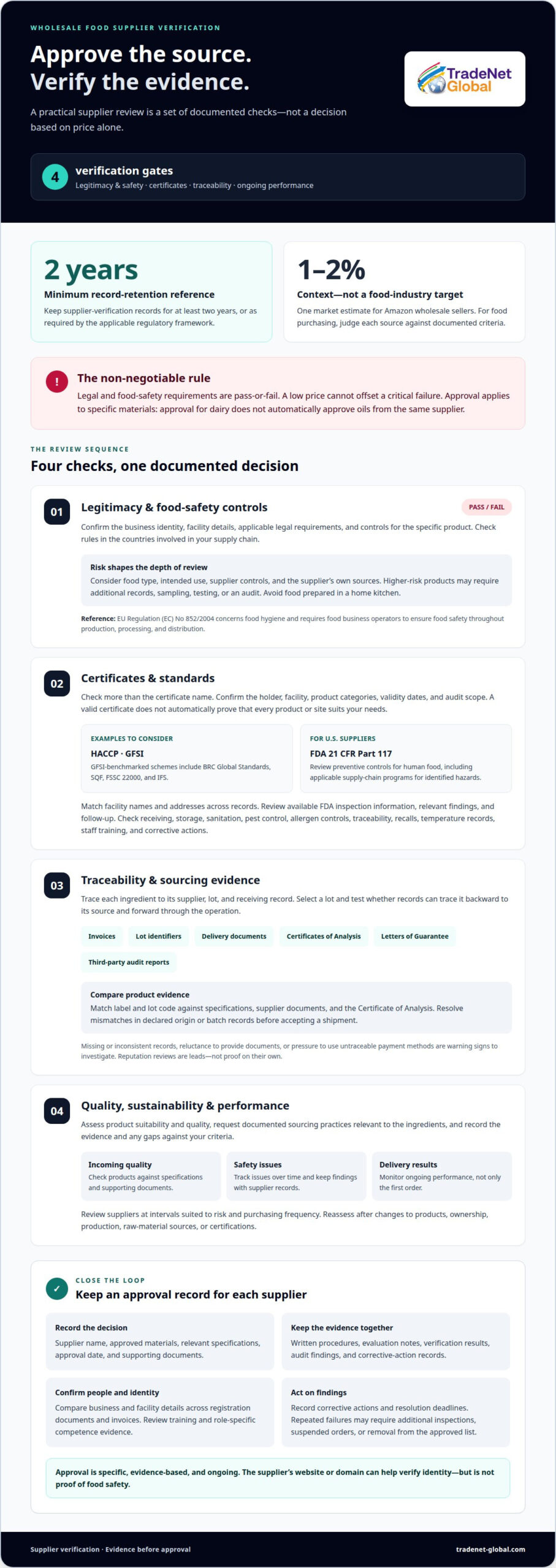
Four checks make supplier approval practical: confirm legitimacy and food-safety controls, review certifications and traceability, assess sustainability and product quality, then monitor safety and delivery performance. When learning how to verify wholesale food suppliers, treat legal and food-safety requirements as pass-or-fail criteria, not issues a low price can offset.
Price, product range, and delivery all matter when choosing a supplier. Approval also depends on evidence that products are traceable, standards are current, and performance remains consistent after the first order.
This guide explains what to review at each stage, from supplier records and certifications to safe wholesale food purchasing checks and delivery results. It also explains how ongoing monitoring can flag problems early and help you decide whether a supplier remains suitable for your business.
Key Takeaways
- Use pass-or-fail food-safety and legitimacy checks before adding a supplier to your approved list.
- Review certification validity and scope alongside the supplier’s applicable food-safety controls.
- Assess whether records support product traceability and provide a clear view of sourcing practices.
- Track incoming quality, safety issues, and delivery performance over time to guide supplier reviews.
1. Approving suppliers and maintaining an approved supplier list
An approved food supplier is a commercial source that has passed your business’s documented checks for legitimacy, product suitability, and food-safety controls. Approval should cover specific materials, not automatically every product a supplier sells. For example, approval for dairy products does not by itself approve oils from the same source.
Start with a pass-or-fail review of essential legal and safety requirements. A low price should never offset a critical failure. EU Regulation (EC) No 852/2004 concerns the hygiene of foodstuffs and requires food business operators to ensure food safety throughout production, processing, and distribution, according to the European Union. Check the relevant rules for the countries involved in your own supply chain.
Create an approval record for each supplier. Include the supplier’s name, approved materials, relevant product specifications, approval date, and supporting documents. Keep written procedures, evaluation notes, verification results, and corrective-action records together. Retain supplier-verification records for at least two years or as required by the applicable regulatory framework.
Use risk to determine the depth of your review. Consider the food type, its intended use, the supplier’s controls, and the supplier’s own sources. Higher-risk products may require additional records, sampling, testing, or an audit. Avoid food prepared in a home kitchen, and do not approve a source that cannot meet essential requirements.
Approval rates need context. One market estimate says most Amazon wholesale sellers approve only 1-2% of suppliers they contact. That figure describes Amazon seller sourcing, not a general food-industry target. For food purchasing, the useful measure is whether each approved source meets your documented criteria.
Approval is ongoing, not permanent. Review suppliers at intervals suited to risk and purchasing frequency. Reassess after changes to products, ownership, production, raw-material sources, or certifications. Record findings, assign corrective actions, and set resolution deadlines. Repeated failures may call for additional inspections, suspended orders, or removal from the approved list.
2. Checking supplier certifications and food safety standards
A practical way to learn how to verify wholesale food suppliers is to assess each certificate’s scope, not just its name. Check the certificate holder, facility, covered product categories, validity dates, and audit scope. HACCP and GFSI are examples to consider. BRC Global Standards, SQF, FSSC 22000, and IFS are GFSI-benchmarked schemes. A valid certificate doesn’t prove every product or site suits your needs.
For U.S. suppliers, FDA 21 CFR Part 117 sets requirements for preventive controls for human food, including supply chain programs when hazards requiring supply chain-applied controls have been identified, according to the U.S. Electronic Code of Federal Regulations. Match the supplier’s program to relevant hazards and controls.
To check FDA registration and inspection history, request the facility’s registration details and inspection records. Match the facility name and address across documents, then review available FDA inspection information for relevant findings and follow-up.
Audit the facility by reviewing receiving and storage, sanitation, pest control, allergen controls, traceability, and recall arrangements. Check relevant temperature records, staff training, and corrective actions. Record findings and deadlines for resolving deficiencies.
For teams learning how to verify wholesale food suppliers, local acceptability is another key check. Food establishments must obtain food from suppliers acceptable to their local regulatory authority. Request references from buyers with a similar scale, product mix, and operating complexity. Their experience can shed light on consistency, responses to issues, and product quality.
Treat the supplier’s website and domain as identity checks, not proof of food safety. Compare the business name, facility details, and contact information with registration documents and invoices. Investigate mismatches, since unclear identities can create liability and disrupt supplier relationships.
Finally, confirm who handles food-safety tasks. Review training records and role-specific evidence of competence, such as how receiving staff record temperatures or report damaged packaging. Keep these records with certification and audit findings to support consistent approval decisions.
3. Reviewing traceability and sustainability practices
Traceability should connect each ingredient to its supplier, lot, and receiving record. Keep invoices, lot identifiers, delivery documents, Certificates of Analysis, Letters of Guarantee, and third-party audit reports together. As a practical test, select a lot and trace it back to its source, then forward through the operation’s records.
To verify product quality, authenticity, labeling, and country of origin, compare the product label and lot code with the specifications, supplier documents, and Certificate of Analysis. Resolve any mismatch between the declared origin and batch records before accepting the shipment.
Warning signs include missing or inconsistent records, reluctance to provide product documents, and pressure to use untraceable payment methods. BBB complaints and third-party reputation reviews can point to recurring issues. Treat them as leads to investigate alongside dated records, not as proof on their own.
Set written sustainability criteria that fit your operation. Ask for documented sourcing practices and evidence relevant to the ingredients you purchase. Record what the supplier reports, which documents support those claims, and any gaps against your criteria. This makes sustainability part of the supplier review rather than an unsupported marketing claim.
A written contract should identify products and specifications, specify documentation, and explain how the parties handle product issues. Review exclusivity clauses carefully, especially terms that prevent purchases from other suppliers. Avoid relying on a contract that does not guarantee constant product prices. Clear terms help protect your supply choices and manage changes.
Reassess the supplier program when products, sourcing, or regulations change, or after a supplier-related food-safety incident. For flour and grain suppliers, formally review the verification program at least annually. Update the record with review findings, revised criteria, and follow-up actions so the next decision reflects current sourcing and traceability evidence.
4. Monitoring supplier quality, safety, and delivery performance
Initial approval is only a starting point. Track incoming acceptance, on-time delivery, order accuracy, nonconformities, corrective-action closure, and traceability performance. These indicators show whether a supplier’s day-to-day results meet your minimum requirements and can flag supply-chain issues before they disrupt operations.
Set delivery measures in a written service agreement. One suggested target is 98% compliance with an agreed two-hour delivery window. Define how delays are reported, with notification within 24 hours if the window cannot be met. Also record temperature and order-accuracy requirements where relevant to the products and transport conditions.
Check product quality at receiving against agreed specifications. Depending on the ingredient, intended use, and identified risks, analysis may include physical measurements, chemical or microbiological testing, sensory review, or manufacturing trials. A passing sample doesn’t establish that every later batch will meet standards. Codex Alimentarius Commission (FAO/WHO) notes that supplier quality-assurance activities, including audits, may suit some ingredients.
Use risk to set inspection and testing frequency. For higher-risk ingredients, sampling and testing before release may be appropriate. If your risk assessment calls for it, consider holding affected material until results are available. Tie results to the lot, date, acceptance decision, and any follow-up action.
Review performance regularly, with check-ins during the first 90 days of a new relationship. Monthly meetings can support new partnerships; quarterly reviews may suit stable relationships. Adjust assessment frequency to supplier risk, performance history, ingredient type, and regulatory requirements. Repeated failures may call for extra inspections, further analysis, order suspension, or removal from the approved list.
Use these measures to guide sourcing decisions. Review wholesale supply options as part of your supplier assessment.
TRADENET GLOBAL
TRADENET GLOBAL is an online wholesale supplier with a searchable store for commercial product sourcing. Once your supplier review is complete and your business needs wholesale products, explore its confectionery, beverages, or beer through the store.
Make the checks in this guide part of your purchasing process. Match product needs to your approved supplier criteria, then keep tracking quality, safety, and delivery performance after orders begin. A product range alone does not replace supplier assessment, so use your documented standards to guide each purchasing decision. When you are ready to source from an online wholesale supplier, explore TRADENET GLOBAL’s store.
Contact TRADENET GLOBAL to discuss your wholesale product needs.
Make supplier review part of purchasing
A supplier decision should not end when an order is placed. Build reviews into your purchasing routine so new evidence can shape future sourcing choices. Assign responsibility for recording issues and updating supplier assessments. This keeps decisions consistent as products, requirements, and business needs change.
Knowing how to verify wholesale food suppliers also helps you set a clear standard for each buying relationship. Apply that standard before orders begin, then use actual performance to decide whether the relationship should continue. For wholesale sourcing beyond food, TRADENET GLOBAL offers confectionery, beverages, and wood pellets through its online store.
If you’re ready to discuss wholesale product needs, contact TRADENET GLOBAL. Take the next step with a sourcing decision that fits your operation.
Frequently Asked Questions
How Do Companies Evaluate Suppliers?
Companies assess suppliers against documented purchasing and risk criteria, then compare the evidence with actual performance. For example, a buyer sourcing a new ingredient can review its specifications, delivery records, responses to issues, and consistency across orders. The assessment should also consider how a disruption would affect production. Record the decision and reasons so purchasing teams can apply the same standards later.
What Are the Main Steps in Supplier Selection?
Supplier selection typically moves from defining needs to screening candidates, reviewing evidence, approving a source, and monitoring results. Start by describing the product, required specifications, and business needs. Then assess relevant documents and operational fit, record the decision, and set expectations for orders. A trial order can reveal practical issues, such as packaging condition or order accuracy, before purchasing expands.
What is an approved supplier?
An approved supplier is a source a business has accepted for specified products after reviewing its requirements and evidence. Approval covers the materials and conditions assessed, not automatically every item the supplier sells. For example, a business may approve one ingredient while keeping a different product outside that approval until it completes a separate assessment.
What should I do if a supplier refuses to comply with my requirements?
Pause approval or purchasing if a requirement is critical to product safety, legal compliance, or your documented specification. Explain the gap in writing and set a clear corrective action, such as providing missing batch records or correcting a labeling mismatch. If the supplier cannot meet the requirement, document the decision and use an already assessed alternative source rather than waiving a critical standard.
Why Is Supplier Selection Important in the Food Industry?
Supplier selection affects whether food inputs meet an operation’s needs and whether problems can be managed effectively. A supplier’s documentation and response process can help a business investigate a quality concern, identify affected deliveries, and decide what action to take. A robust selection process also supports consistent purchasing decisions instead of relying on price or familiarity alone.
What licenses and permits should a wholesale food supplier have in the United States?
There is no universal license list for every U.S. wholesale food supplier. Applicable requirements depend on the supplier’s activities, products, and jurisdictions. Request relevant business and facility documents, then establish which federal, state, or local requirements apply to that operation. The local regulatory authority can clarify supplier acceptability. Review document scope and validity as part of your assessment.
